
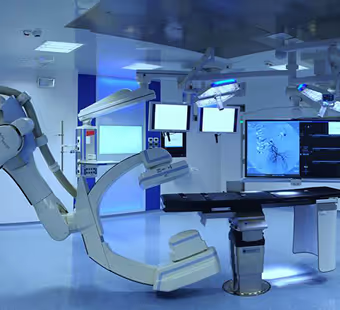
How much should you spend on medical photography equipment?Without a doubt, your office needs to take photos of your patients on a daily basis. Whether you’re building a before and after portfolio for marketing, using photography for after procedure tracking or expectation management, you want your pictures to look clean and consistent. Very few offices have a skilled photographer on staff, so it can be difficult to decide on the best camera to use for your medical photography. In this article, we profile the pros and cons of the three most common options (DSLR camera, medical imaging system and a mobile device) for aesthetic photography:
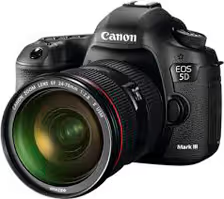
DSLR
Many physicians choose a DSLR camera for their clinical photography, and most set up a dedicated photography room to ensure that their pictures remain consistent shot after shot. A skilled photographer can set a DSLR camera with the proper aperture for the room’s lighting, choose the correct lens, and set up a tripod for the camera at good distance and angle from the subject.
PROS
- Many features to custom tailor your pictures to adjust for lighting, movement, distance from subject, etc.
- Compatible with most standard tripods for moderately increased mobility.
- Can be used like a point-and-shoot camera in “auto” mode.
CONS
- “Auto” mode will not always set the camera to the best possible settings, so customization is still needed for white balance, exposure, aperture, ISO, f-Stop, etc.
- Taking quality pictures requires either a photographer to be trained by the practice, or the staff to be trained to use the camera properly.
- A DSLR camera station needs a dedicated photography room resulting in the shuttling of patients from room to room, and requiring patients to wait their turn to take photos.
- Photos must be manually uploaded from the SD card to a computer to be stored. As a result, photos are not easily searchable.
Ultimately, DSLR cameras have many features but they only benefit you if your staff is trained to use them. Without proper training, you are essentially paying a lot more money for a glorified point-and-shoot digital camera.
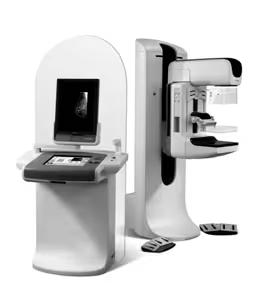
Medical Imaging System
Dedicated medical imaging hardware products are designed for use in clinical photography. Some are made specifically for taking photos of the face, some for full body photography, and some are similar to DSLR cameras in that they are handheld and used to document any anatomical region. Most physicians set up a photography room specifically for using these types of cameras.
PROS
- Imaging systems are designed for specific applications and help manage both photo quality and consistency.
- Imaging systems come with photo management software which allows the user to more accurately catalog medical photos.
CONS
- Up Front cost of $15,000+
- Hardware can become outdated in a few years – convenient for the manufacturer as a means to upsell you the newest version.
- Staff members will require a high level of training to operate the software and hardware to attain high quality images.
- The size of the equipment limits the ability to move the camera from one room to another. This usually means the practice must have a dedicated photography room, limiting other potential uses for your office space.
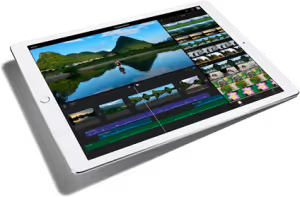
Mobile Devices
Because of the upfront cost of DSLR cameras and medical imaging hardware, it may be no surprise that doctors are using mobile devices such as tablets and smartphones: especially since the quality of mobile device cameras has been improving at a staggering pace.
PROS
- Highly portable devices that can be brought into any exam room.
- Any preferred device such as iPhone, iPad, Android phone, Android tablet, etc. may be used.
- Extensive training for staff member is not required.
- Excellent camera specs without useless features. For instance, the iPhone 7 boasts dual lenses with 28 and 56mm focal lengths, an f/1.8 aperture, optical image stabilization, and an even brighter flash – more than enough to create quality patient photos.
CONS
- Not HIPAA compliant.
- Limited sensor and lens sizes.
Mobile Devices versus DSLR
Smartphone and tablet cameras are often just as good, if not better, than standard point-and-shoot digital cameras. They do not have the features of a DSLR camera such as swappable lenses, adjustable aperture for varying amounts of light, or larger sensors for larger printouts. These features are overkill for you purposes, when a less expensive, mobile device can do the job required of your photography equipment. If treated like a DSLR camera by using consistent lighting and consistent set-up, a mobile device can take images of the same caliber as the DSLR.
Mobile Devices versus Medical Imaging Systems
Imaging hardware products we discussed are designed specifically for clinical photography. While image quality on a smartphone or tablet is suitable for most physicians’ needs, perhaps you are worried about repeatability, a feature that companies such as Canfield and FotoFinder stress. Apps such as RxPhoto work on smartphones and tablets (currently iOS) that incorporate all the most important features you have with expensive imaging system cameras, proving that mobile devices are just as efficient and more versatile than bulky clinical photography studios:
- On screen templates and ghosting features allows “after” pictures to be perfectly aligned with “before” pictures, so that two different photographers can take the same picture at two different times.
- Automatically sorts and organizes your photos by patient, date, and anatomical region.
- Automatically stores your photos on a HIPAA-compliant cloud server that you can access from any office computer.
- Staff training is minimal.
- Staff can bring their own devices, limiting big equipment purchases.
Mobile device cameras are continually improving. Apple has even touted that the iPhone 7 will kill the DSLR. As these cameras continue to advance, you will find more and more doctors using them with apps such as RxPhoto for their ease of use, portability, and financial benefit – taking costs down from thousands of dollars to just hundreds.
Explore this post
Book a demo to see RxPhoto in action