
Quick summary
Most aesthetic practices have thousands of patient photos and a handful they can publish. Camera quality is rarely the reason. The before and the after were taken in different light, at different angles, from different distances, by different people, months apart, so the pair cannot be shown side by side without the difference in the photograph competing with the difference in the result. This guide covers the five variables that decide whether a pair is usable, how to standardize them across a team without slowing anyone down, whether you need a real camera, and what to do with a back catalog that is already inconsistent.
Why are most patient photos unusable for marketing?
Because a before and after pair only works when the photograph is the constant and the patient is the variable. Change anything about the photograph and the comparison stops being readable.
Consider what usually happens. The before is taken in the consult room under warm overhead light, on whichever phone was nearest, from wherever the staff member happened to stand. The after is taken twelve weeks later in the treatment room under cooler light, on a different phone, slightly closer, from a slightly different angle, by a different team member. The result may be excellent. The pair still cannot be published, because a viewer cannot tell how much of the change is the treatment and how much is the lighting and the distance.
This is why the complaint that photos are too poor quality to market is usually a misdiagnosis. Individually the images are fine. As pairs they are unusable, and no amount of camera upgrade fixes that. The fix is that both halves have to be taken the same way, which is a process problem rather than an equipment one.
There is a second reason worth naming. Practices that do have a compliant, consistent set often still cannot use it, because consent was never obtained for marketing. A beautiful, perfectly matched pair with no marketing authorization is exactly as unusable as a mismatched one.
The five variables that decide whether a pair works
Control these five and almost any camera produces publishable results.
Angle. The single biggest factor. A face photographed a few degrees off from the before reads as a different shape, not a different result. Fixed positions are what solve this: front, left oblique, right oblique, left profile, right profile, captured in the same order every time so nobody has to remember.
Distance and framing. Moving closer flatters, and a viewer notices. The subject should occupy the same proportion of the frame in both images, with the same anatomical landmarks included at the edges.
Lighting. The same light source, the same direction, the same color temperature. Mixed light is the usual culprit: a window plus warm overheads gives a different result at 9 AM in June than at 4 PM in November. Consistent artificial light in one dedicated spot beats better light that varies.
Background. One plain background, ideally a neutral mid-tone in a fixed location. A cluttered or changing background pulls attention and makes two images obviously separate occasions.
Patient presentation. Hair pulled back the same way, makeup removed for facial work, jewelry out, the same neutral expression, the same posture. For body work, the same clothing or draping and the same stance. Expression alone can change an apparent result significantly around the eyes and mouth.
None of the five requires equipment. All five require the same thing to happen twice, which is why the answer is a process.
How do you keep photos consistent across staff?
You remove the judgment. Every variable left to a person's discretion will vary between people, and between the same person on a busy day and a quiet one.
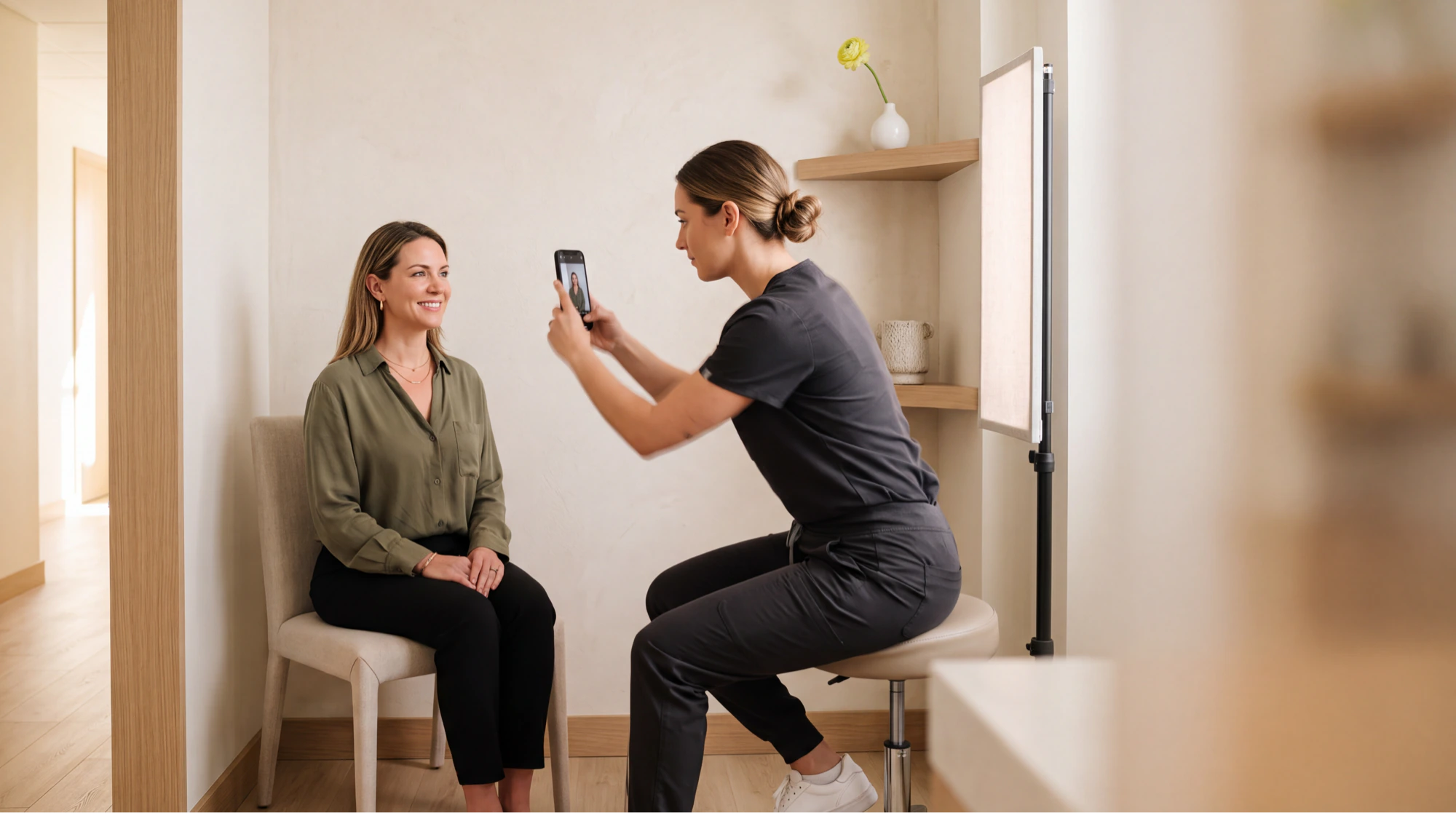
Have one place where photos are taken. A designated spot with fixed lighting and a fixed background eliminates three of the five variables permanently. It does not need to be a room. A marked position against a plain wall with a consistent light works.
Mark the floor. A piece of tape where the patient stands and a mark where the photographer stands fixes distance, which is otherwise the most variable thing about a handheld photo.
Use overlay or ghosting when capturing the after. Showing the before image as a faint overlay while framing the after is the single most effective technique available, because it turns matching from memory into alignment. Anyone can line up a live view against a ghost. Nobody can reliably reproduce an angle from three months ago.
Standardize the sequence. The same views, in the same order, every time. A named protocol per treatment type, so the person capturing does not decide what to take.
Train once, then make it the default. Fifteen minutes with the whole team, then a printed card at the photo station. The habit sticks when the standard path is also the fastest path.
Check at capture, not at publication. The cost of a bad photo is discovering it twelve weeks later when the patient is in front of you and the before cannot be matched. A quick look before the patient leaves the room is the whole quality control system.
Do you need a professional camera?
For most aesthetic marketing, no. A current phone camera in controlled conditions beats a professional camera in uncontrolled ones, comfortably.
The honest breakdown is this. Phone cameras are excellent in good light, always present, fast enough that staff actually use them, and produce images well beyond what social media and a website gallery require. Their weaknesses are real but narrow: wide lenses distort facial proportions at close range, computational processing smooths skin texture in ways that can flatten exactly the detail you are documenting, and automatic exposure and color adjust shot to shot, which works against consistency.
Two of those three have simple fixes. Step back and use the standard lens rather than the ultra-wide, which removes most of the distortion. Use an app that locks exposure and white balance rather than the default camera, which removes most of the shot-to-shot variation.
A dedicated camera earns its place in specific situations: fine skin texture work where computational smoothing hides the finding, clinical documentation for publication or medicolegal use, and practices doing high-volume surgical before and afters where the standard is higher. For a med spa marketing injectable and skin results, consistency limits the set long before the phone does.
The one place to spend money, if you spend anywhere, is lighting. Consistent, diffuse, front-facing light in a fixed position improves every photo taken from that day forward and costs less than a camera body.
How do you stop staff taking photos on their own phones?
Give them something faster than the workaround, and make the compliant path the default rather than the extra step.
Staff use personal phones because the phone is in their pocket and the alternative was slower. If the approved method requires walking to another room, logging into a desktop, and manually attaching an image to a chart, the phone wins every time regardless of policy. A capture path that opens on a device already in the room, attaches to the patient record automatically, and takes less time than the camera roll route wins on its own merits.
The policy still needs to exist and be written down: patient photographs are captured only in the approved system, never on personal devices, never sent by text. Put it in onboarding, because new hires default to the phone unless told otherwise, and add photo removal to the offboarding checklist, because right now patient images leave with departing staff in many practices.
The compliance case is covered separately in our guide on why the phone gallery is not HIPAA compliant. The reason it is worth solving here is that the same fix produces both outcomes: images that are legally safe and images that are consistent enough to publish, because a controlled capture path standardizes the photograph as a side effect of securing it.
What to do with an inconsistent back catalog
The existing library is usually not a lost cause, but it is not a project worth much time either.
Sort it once against a simple test: can the before and after be shown side by side without the difference in photography competing with the difference in result? Most pairs fail, some pass, and a few are strong. Pull the ones that pass into a usable set, confirm marketing authorization exists for each, and stop there.
Do not attempt to retouch inconsistent pairs into matching. Adjusting lighting or color to make an after look better is treated as deceptive advertising under several state rules. It is the fastest way to turn a marketing asset into a complaint. Cropping to match framing is generally acceptable; changing the apparent result is not.
Then set the date and treat everything from it forward as the real library. A practice that standardizes capture today has a strong, consistent, publishable set within one treatment cycle, which for most injectable and skin work is a matter of weeks to a few months. That is faster than any attempt to rescue the back catalog, and the result is better.
How RxPhoto approaches this
RxPhoto is built for exactly this problem: making the photograph the constant so the result is the variable.
Capture runs on a standardized protocol per treatment type, so the same views are taken in the same order regardless of who is holding the device. Overlay guidance shows the before image while framing the after, which is what makes matching reliable across staff and across months. Images go straight into the patient record in a HIPAA-compliant, access-controlled store rather than the camera roll, which is what gets photography off personal phones without adding a step. Consent status travels with the image, so the question of what can be published is answered where the photo lives.
The reason practices adopt it is usually compliance. The reason they keep it is that a year later they have a marketing library instead of an archive.
Related reading
- A guide to capturing transformation photos
- Lighting, backgrounds and shadows
- The before and after photo checklist
Frequently asked questions
How many angles should we capture?
For facial work, five is the standard set: front, both obliques, both profiles. For body work, capture the treatment area from the front, both sides, and the back where relevant. More views cost little at capture and are impossible to add later, so err toward the full set. The important thing is that the set is the same every time.
How soon after treatment should the after photo be taken?
It depends on the treatment, and the rule is to be consistent and to state the interval. Neurotoxin results are typically assessed around two weeks, filler once swelling settles, skin treatments over a longer arc. Whatever interval you choose, use the same one for every patient in that category and say what it is when you publish, because an unlabeled interval is the most common thing that makes a gallery look unreliable.
Can we use a phone if we already own a professional camera?
Yes, and many practices do both: the camera for surgical documentation and the phone for routine before and afters. The mistake is mixing them within a single pair. A before on a camera and an after on a phone will not match on color or lens character. Pick one per patient journey and stay with it.
Should we ask patients not to wear makeup?
For facial treatments, yes, and it needs to be in the appointment reminder rather than raised at the door. Makeup is the single biggest confounder in facial before and afters, and it changes the apparent result more than most treatments do. For body work, the equivalent is consistent clothing or draping and the same stance.
What about photos patients take themselves at home?
They are useful for monitoring between visits and are rarely publishable, because none of the five variables are controlled. If you want to use them clinically, ask for them through a secure path rather than by text, and keep them distinct from the marketing set so the two do not get confused later.
If you want to see how overlay-guided capture works across a team, book a walkthrough of RxPhoto.
This guide is general information about clinical photography and its marketing use. It is not legal advice, and state advertising rules vary.
Explore this post
Book a demo to see RxPhoto in action