

Quick summary
Healthcare clinics face growing risks of data breaches, compliance violations, and patient trust issues due to improper handling of protected health information. A compliant HIPAA Notice of Privacy Practices clearly explains data use, patient rights, and privacy obligations. Secure digital workflows also simplify documentation, acknowledgments, and ongoing compliance with federal regulations.
Your aesthetic clinic needs a HIPAA privacy notice
In 2025 alone, over 61 million individuals were affected by large healthcare data breaches. Aesthetic clinics hold sensitive patient data, treatment histories, photos, and contact details, making them a prime target.
That’s exactly why a HIPAA privacy notice is your first line of defense. It explains how you collect, use, and protect patient information. Without one, your clinic risks OCR audits, fines, and damaged patient trust.
Fortunately, getting it right doesn’t have to be complicated. This guide covers everything your aesthetic practice needs to build a compliant, patient-friendly HIPAA privacy notice.
What is a HIPAA Notice of Privacy Practices?
A HIPAA privacy notice, formally called a Notice of Privacy Practices (NPP), is a written document that explains how your practice collects, uses, and shares patients' protected health information (PHI). U.S. federal law requires every covered healthcare entity to provide one.
Patients receive it at their first visit and must acknowledge it in writing. Due to that, a notice of privacy practices should be detailed, leaving no room for patient confusion or misunderstanding.
In practice, it works as your clinic’s commitment to data transparency. It protects patients while shielding your practice from regulatory exposure.
Which aesthetic practices need a HIPAA Notice of Privacy Practices?
If your practice collects, stores, or transmits protected health information, federal HIPAA privacy notice requirements apply to you. This includes most aesthetic practices operating in the U.S. today.
The following types of practices are required to maintain and distribute a compliant NPP:
- Med spas offering injectable treatments, laser services, or skin rejuvenation.
- Plastic and cosmetic surgery practices handling pre- and post-operative documentation.
- Dermatology clinics managing clinical photos, treatment records, and prescriptions.
- Dental practices providing cosmetic procedures, like Botox or facial injectables.
- Weight loss and wellness clinics collecting intake forms and health histories.
If your team captures before-and-after photos, stores patient forms and notes, or shares data with billing partners or labs, you qualify as a covered entity. That obligation doesn’t shrink based on practice size. A single-provider med spa has the same core requirements as a multi-location clinic collection.
Practices must also be mindful of the grey areas. If you use a third-party booking platform, patient communication tool, or cloud storage solution, those vendors likely handle PHI too. As a result, your HIPAA privacy notice needs to account for them as well.
What must a HIPAA Notice of Privacy Practices include?
Your HIPAA Notice of Privacy Practices isn’t a document you draft once and forget. Federal law specifies exactly what it must contain, and missing even one required element can expose your clinic to OCR scrutiny. Here’s what every aesthetic practice needs to cover:
- Patient rights over personal information
Patients have federally protected rights regarding their PHI. Your NPP must clearly explain each one so patients know what they can request and how:
- Right to access and obtain copies of their health records.
- Right to request corrections to inaccurate or incomplete information.
- Right to restrict how their data is used or shared.
- Right to receive a record of disclosures made about their PHI.
- Right to receive communications through preferred channels.
- Right to file a complaint with your practice or the HHS office for civil rights.
- How your practice uses and discloses PHI
This section tells patients exactly when and why their information leaves your practice. Aesthetic clinics must disclose all standard and non-standard uses, which include:
- Treatment coordination among your clinic team.
- Billing and insurance processing.
- Healthcare operations, like quality reviews and staff training.
- Disclosures required by law, such as public health reporting.
- Sharing with business associates handling PHI on your behalf.
- Your practice’s legal duties
Patients need to know your clinic takes its obligations seriously. This section reinforces the legal framework behind your privacy commitments, including:
- Your duty to maintain the privacy of PHI.
- Your duty to follow the terms of your current NPP.
- Your right to update the NPP and how patients will be notified.
- Contact details for your clinic’s privacy officer or designated compliance contact.
Where should aesthetic clinics post their HIPAA privacy notice?
Placement matters as much as the content. Your NPP must be available at the point of care and easy for patients to find before they share any personal information.
With that in mind, distribute and display your HIPAA privacy notice in the following areas:
- Clinic reception: Post a physical copy for patients to read before checking in.
- New patient intake packets: Include them alongside consent forms and clinical photography releases.
- Your practice website: Publish the full NPP on a dedicated, clearly labeled page.
- Patient portal: Make it accessible within any digital platform patients use to manage their care.
- Email communications: Attach or link it when sending appointment confirmations or intake instructions to new patients.
Does a patient need to sign an NPP?
Keep in mind that what patients actually sign is an acknowledgment of receiving an NPP. Your clinic must make a good-faith effort to obtain written acknowledgment at the first point of service.
If a patient refuses to sign, simply document the attempt and move forward. The refusal doesn’t block treatment.
From there, keep a signed acknowledgment in each patient’s file. OCR audits look for this documentation, and missing records can complicate your defense.
Common HIPAA notice mistakes aesthetic practices make
Even well-run medical aesthetic clinics slip up on NPP compliance. Most mistakes aren’t intentional, since they often stem from outdated templates or rushed onboarding. Here are the ones OCR notices most often:
- Using a generic template: A downloaded NPP needs to reflect your specific services, third-party vendors, and disclosure practices.
- Failing to update after operational changes: As your practice grows, the services you render might change. It’s important that your NPP is included in this change. Many clinics forget.
- Not posting the notice on your website: Federal laws require your NPP to be publicly accessible online. A missing or buried page is an obvious compliance gap.
- Skipping written acknowledgment at intake: Verbal confirmation is not enough. Without a signed acknowledgment on file, you have no documented proof that the patient received the notice.
- Distributing an outdated version: Handing patients a notice that no longer reflects your current privacy practices could create a legal issue.
- Overlooking business associates: If a vendor handles PHI on your behalf, your NPP must account for that relationship.
How digital intake workflows simplify HIPAA compliance
Paper-based intake leaves room for compliance gaps. Forms get lost all the time, causing staff to waste valuable time chasing documentation that should already be on file.
Digital intake workflows close those gaps by building acknowledgment into the process itself. When your NPP is part of patient onboarding, the sign-off happens automatically, so every record is in order well before the first appointment.
Platforms built for aesthetic practices, like RxPhoto, go a step further. By seamlessly integrating consent management, clinical photography, and patient documentation, they enable your team to capture signatures, store records, and maintain a complete audit trail in one place.
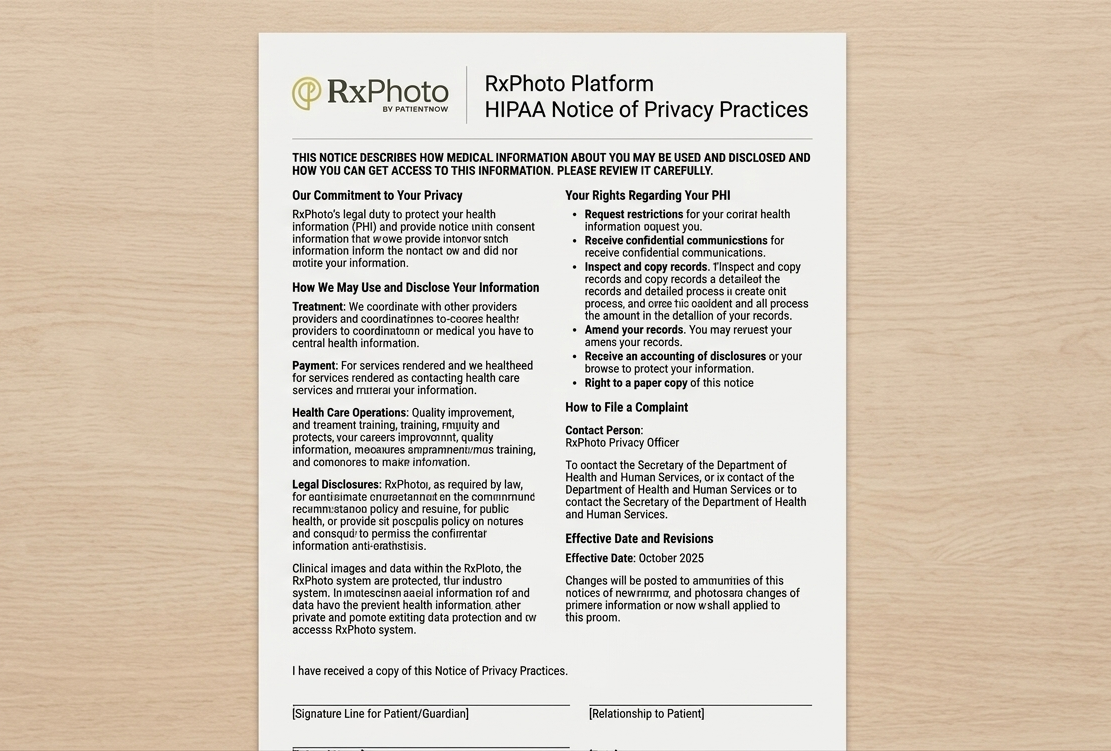
Free HIPAA Notice of Privacy Practices template
Writing your NPP from scratch is time-consuming and easy to get wrong. To make it simpler, use the template below as a starting point. For deeper compliance resources, explore our library of ebooks and guides built for aesthetic practices.
Secure patient management facilitates compliance
A compliant HIPAA Notice of Privacy Practices is essential for protecting patient information and meeting federal requirements. But maintaining compliance is much easier when your workflows are built around secure, centralized tools instead of paper forms, personal devices, and scattered records.
RxPhoto helps aesthetic practices simplify compliance with HIPAA-secure clinical photography, digital consent forms, and patient documentation in one intuitive platform. By keeping photos, records, and acknowledgments organized in a single system, your team spends less time managing paperwork and more time delivering exceptional patient care.
Ready to tighten up your compliance workflow? Book a demo with RxPhoto today.
Frequently asked questions
Do small aesthetic practices need a HIPAA privacy notice?
Yes. Practice size doesn't affect the requirements. Any clinic that collects, stores, and transmits protected health information qualifies as a covered entity and must maintain a compliant NPP.
How often should an aesthetic clinic update its NPP?
Update your NPP whenever your privacy practices change. New vendors, added services, or new software handling PHI all trigger a revision. At a minimum, review it once a year.
What happens if a patient refuses to sign the acknowledgment?
Document the refusal in writing and proceed with care. A patient's refusal to acknowledge receipt doesn't block treatment or eliminate your obligation to provide the notice.
Would a general HIPAA template found online be enough?
Only as a starting point. Generic templates rarely reflect your specific operations, vendors, or disclosure practices, so customize any template to fit your clinic.
Is a digital HIPAA privacy notice legally acceptable?
Yes, provided patients can access and acknowledge it before their first appointment. Digital delivery through a patient portal or intake form meets federal requirements when properly documented.
Explore this post
Book a demo to see RxPhoto in action