
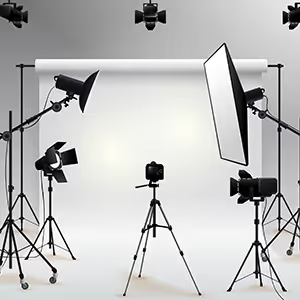
Here at RxPhoto, a question that aesthetic clinic owners and operators regularly ask us is whether it is beneficial to have a dedicated photography room for patients, or if capturing all patient photos in the exam room is sufficient.

We usually provide a two-part answer.
- Firstly, it depends on the clinic. Every practice is unique with respect to size, patient flow, room availability, and budget. The only way that an assessment can be made is if the office is seen in person.
- A photography room can be highly advantageous in the right context. For some clinics, a photography room can streamline the patient photography process and yield financial benefits. For others, it would represent a costly waste of time and space, and taking photos within the consultation room or office represents a preferable option.
In this article, we’ll unpack the benefits and disadvantages associated with having a photography room, to help you assess what is most suitable for your clinic. We’ll also highlight how RxPhoto’s tools can help you improve your patient before and after images regardless of where the photographs are taken.
Dedicated Photography Rooms: The Benefits
In a perfect world, every aesthetic clinic or med spa would have its own dedicated photography room. Purpose-built photography rooms allow for:
1. Standardized lighting
Practitioners use before and after photographs to demonstrate successful results and emphatically market their treatments. Images with inconsistent lighting, however, can alter an individual’s appearance and affect the transparency of results.
Standardized photographs are demanded by the industry, media, and patients to allow for accurate comparison, and this can be achieved in part by ensuring identical lighting in all photos. Most critically, patients can see their own results following a procedure and feel vindicated about the money they have spent on the treatment. Purpose-built photography rooms can have studio-quality lighting installed to ensure this level of consistency.
2. An uncluttered atmosphere without equipment or products in the way
Patients walk in before or after their consultation, have their photo taken, and leave. There is no need to find a space to hang a collapsible backdrop, set up a light, or move bulky items out of the way.
3. Consistent backdrop
Photography rooms usually have a blank wall or backdrop in front of which photographs are taken. Uniform backgrounds ensure that images have background consistency, allowing for easy, transparent comparison between before and after shots, without distracting changes in the background environment.
4. Improved client retention
Some aesthetic clinics have noted that a dedicated photography room improves their clinic’s revenue. Better quality photographs can mean improved client retention, or the ability to attract new clients.
Ideally, one dedicated, savvy photographer would capture images of patients. When the same person takes photographs, the chances of attaining image standardization and consistency is significantly increased.
However, a dedicated photography room is not without drawbacks.
For the vast majority of aesthetic clinics, a dedicated photography room and photographer is out of the question. Why?
- Cost: A photography room represents a considerable cost, mainly if it will be infrequently used when it could be used to generate income from treatments and procedures.
- Space: A photography room may also be an inefficient use of space. If your clinic is on the petite side, a photography room might be better utilized as a consultation or treatment room to hold laser machines, CoolSculpting machines, or similar.
- Logistical difficulties: Instead of keeping patients in one room and photographing them there, patients will need to be shuttled from the examination or consultation space to the photography room. It’s possible several patients may need photos at the same time in a busy clinic causing logistical issues.
- Time: Setting up a patient in a photography room can be more time-consuming than simply photographing them during their consultation. For patients who want to be in and out of their appointments as quickly as possible, this may represent an off-putting inconvenience.
- Hiring a professional photographer: Hiring a dedicated person to capture and manage patient images may not be financially feasible. If your clinic doesn’t have a dedicated photographer, however, consistency will be negatively affected if different members of staff take the photos.

Whether your clinic prefers to capture photos in a dedicated photography room or in an exam room, RxPhoto’s Patient Photography Software can help with standardization, consistency, and educating your patients.
If you’re using an office or consultation room for patient photography, here’s what we advise.
- Set up your clinic’s examination rooms with standardized backgrounds. Collapsible backdrops are ideal, particularly ones which can be hung easily from a wall. Blue is often an excellent background color because it provides a sharp contrast with human skin tones. Many clients also use black, which helps to conceal any potential shadows. Ensure the background is one consistent tone and is not made of reflective material.
- Set up your examination room to have consistent lighting. Achieving perfect lighting may take some time and tinkering to set up, but it’s vitally important. There are multiple factors to consider such as color temperature, blackout shades, types of light, and eradication of shadows. We recommend that our clients browse our comprehensive guide to lighting and photography for cosmetic dermatology. Everything you need to know about clinical lighting for patient photographs can be found there.
- Use a service like RxPhoto to standardize your photographs. Aesthetic practitioners are not photographers. Many lack the training to achieve image standardization on their own, even if they are using a dedicated photography room. Standardizing photographs can also be something that is very time-consuming to get correct. RxPhoto standardizes the distance, angles, and rotations of images so your patients’ before and after transformations are immediately visible. Standardization is easily achieved using our photo ghosting feature. You don’t need to worry about the same staff member taking the before and after photos to ensure consistency — RxPhoto does the hard work for you.
- If you use a mobile device to capture patient photographs, opt for a newer generation iOS device to capture your photographs. While iPhones do not have the same capability as a DSLR, newer models such as the iPhone X offer comparable quality with their dual lens feature. These dual lenses have different magnifications, allowing for a form of zoom with sharper images. Although you may not have a dedicated photography room with a professional photographer, your mobile, used in conjunction with RxPhoto, can ensure you achieve comparable results.
- If you want to use your DSLR, RxPhoto also offers DSLR integration which allows you to use all of its on-screen positioning templates and patented photo ghosting feature with your DSLR camera. For clients who have a dedicated photography room, this is the ideal solution to capture standardized and consistent patient photos with maximum image quality.
Wherever you take your photos, RxPhoto can improve patient photography.

RxPhoto is HIPAA compliant, cloud-based, and secure. Because patient photos are stored in a cloud, photos can be accessed by any device that is logged on to the RxPhoto app at any time. Patient photos can be captured and browsed in multiple exam rooms simultaneously, improving patient flow.
RxPhoto allows you to improve the quality, standardization, and consistency of patient photos while decreasing the time it takes to capture photos whether you use a dedicated photography room or not. The outcome? Better patient flow, enhanced time management, and improved revenue for your clinic.
In our next blog, we’ll discuss the importance of streamlining the consent form process, and how RxPhoto can improve your clinic’s efficiency in handling forms.
Explore this post
Book a demo to see RxPhoto in action