

Quick Summary
The best HIPAA-friendly patient intake form options for med spas combine secure data collection with workflows that fit aesthetic practices. For aesthetic practices, these forms should balance medical-grade compliance with a seamless, pain-free patient experience. Here are the top 3 options at a glance:
Paperwork Shouldn't Be Your Biggest Risk
Your front desk collects patient names, medical history, allergies, and consent signatures every single day. If any of that information is stored, shared, or transmitted outside HIPAA standards, your practice is exposed. All it takes is one unsecured form or missed signature to trigger fines, lawsuits, and lost patient trust.
HIPAA-friendly patient intake forms take that risk off the table. This guide covers 8 options built to keep med spas and aesthetic practices compliant without slowing down your workflow.
Why Listen to Us?
RxPhoto has spent over a decade building clinical photography, documentation, and intake tools for aesthetic practices. From single-provider offices to multi-location clinics, we've seen what works when it comes to collecting patient information securely. That experience, combined with hands-on knowledge of aesthetic workflows, shapes how we evaluate these tools.

What Is a HIPAA-Friendly Patient Intake Form Tool?
A HIPAA-friendly patient intake form tool collects, stores, and manages protected health information (PHI) within HIPAA guidelines. For med spas and aesthetic practices, these tools replace paper forms with encrypted digital alternatives. They include secure storage, electronic signatures, and access controls that keep patient data protected.
Data privacy is non-negotiable in aesthetic care, especially when patients share sensitive treatment histories and medical photos during intake. A HIPAA-friendly form tool lets you send onboarding forms, consent documents, and treatment questionnaires that stay encrypted. Only authorized team members can access them, so you can focus on patient care.
Components of a HIPAA-Compliant Online Intake Form
To align with HIPAA standards, your intake forms should include:
- Patient identification and contact details.
- Emergency contact information.
- Medical history, medications, and allergies.
- Insurance information (if applicable).
- HIPAA Notice of Privacy Practices acknowledgment.
- Consent for treatment and/or data use.
Benefits of HIPAA-Compliant Online Intake Forms
HIPAA-compliant online forms protect patients and reduce workload across your entire team. They also remove the guesswork around compliance, so clinical staff can focus on care rather than paperwork risk. Here are their benefits for different users:
For Providers and Staff
- Less time on data entry: When forms sync with your EHR, staff stop re-entering patient data by hand. That means fewer transcription errors and faster record updates.
- Automated form delivery: Workflows handle sending, signature capture, and record filing without manual effort. Staff know exactly who completed their forms and who still needs follow-up.
- Cleaner billing and insurance processing: Accurate patient data from the start reduces rejected claims and billing corrections down the line.
- Audit-ready documentation: Digital intake tools log every access and change automatically. If a compliance question comes up, those records are already in place.
- Faster consultations: Providers walk into appointments with complete patient information instead of waiting for front desk staff to chase missing paperwork.
For Patients
- No more waiting room paperwork: Patients complete intake forms from their phone or computer before their visit. So, there’s no clipboards, or rushing through medical history questions at the front desk.
- More accurate records: Patients enter their own information directly, which reduces the errors that come from staff transcribing handwritten forms.
- Confidence in data security: Patients know their information is encrypted and stored securely. For aesthetic patients sharing sensitive treatment goals, that trust matters.
- Faster check-ins: With forms already submitted, patients spend less time in the lobby and more time with their provider.
Top 8 HIPAA-Friendly Patient Intake Form Options
Before breaking down each tool in detail, here’s how they compare side-by-side across use cases, key strengths, and considerations:
1. RxPhoto
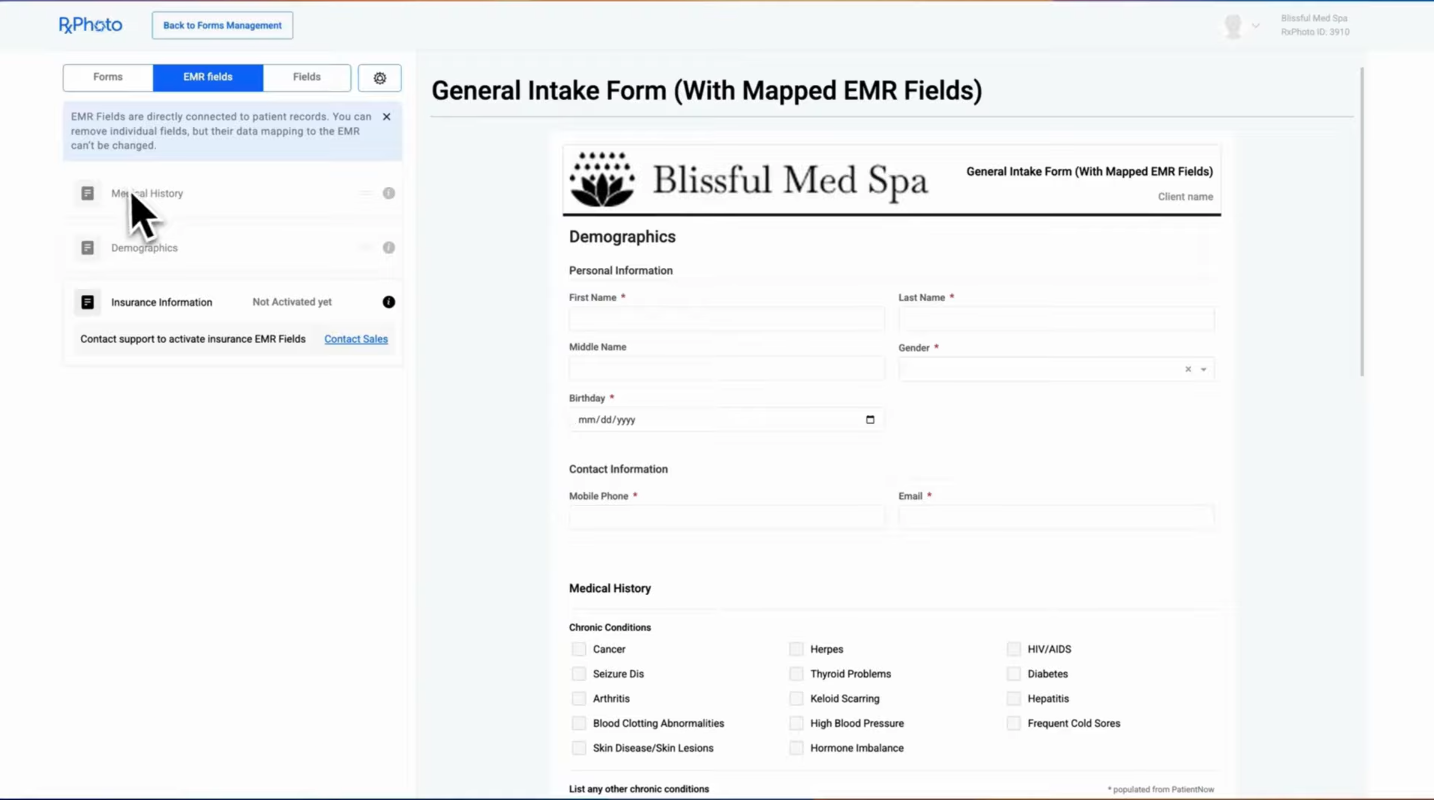
RxPhoto is a HIPAA-compliant platform built for med spas and aesthetic practices. It combines clinical photography, documentation, and patient intake in one connected system. On-screen ghosting overlays and guided positioning also ensure consistent imaging across staff and visits.
In addition, customizable intake and consent forms collect patient information ahead of appointments and attach directly to each patient's record.
What makes RxPhoto different from general form tools is the connection between documentation and intake. Consent forms, treatment photos, and clinical notes all exist in the same patient record. So, staff don't have to switch between platforms to find what they need during a consultation.
Key Features
- Guided photo capture with ghosting overlays for consistent before-and-after imaging.
- HIPAA-compliant digital storage with no complex configuration required.
- Customizable consent and intake forms attached directly to patient records.
- Side-by-side before-and-after comparisons for patient consultations.
- Mobile-first interface that staff can use confidently from day one.
Pros
- User-friendly and intuitive across clinical and front desk staff.
- Streamlined workflows that connect intake, photos, and documentation.
- Consistent, professional-grade photography across all staff members.
Cons
- Hard to track which patients have been reviewed across large photo libraries.
2. Jotform

Jotform is a no-code form builder used across industries, including healthcare. It offers HIPAA compliance on its Gold and Enterprise plans, which include encryption, audit logs, and a signed BAA. For med spas, Jotform's strength is flexibility. You can build intake forms, consent documents, and surveys quickly using a drag-and-drop editor.
It’s worth noting that Jotform is not healthcare-specific. If your practice needs forms that connect directly to patient records or clinical workflows, you'll need to build EHR integrations manually.
Key Features
- Drag-and-drop form builder with no coding required.
- HIPAA compliance with encryption and BAA on Gold and Enterprise plans.
- E-signatures, file uploads, and payment collection within forms.
- 200+ integrations with third-party tools and platforms.
Pros
- Fast setup with thousands of templates available.
- Intuitive interface that non-technical staff can learn quickly.
Cons
- HIPAA compliance requires the Gold plan at $99/month minimum.
- EHR integration is not native and needs third-party connectors.
3. Solutionreach
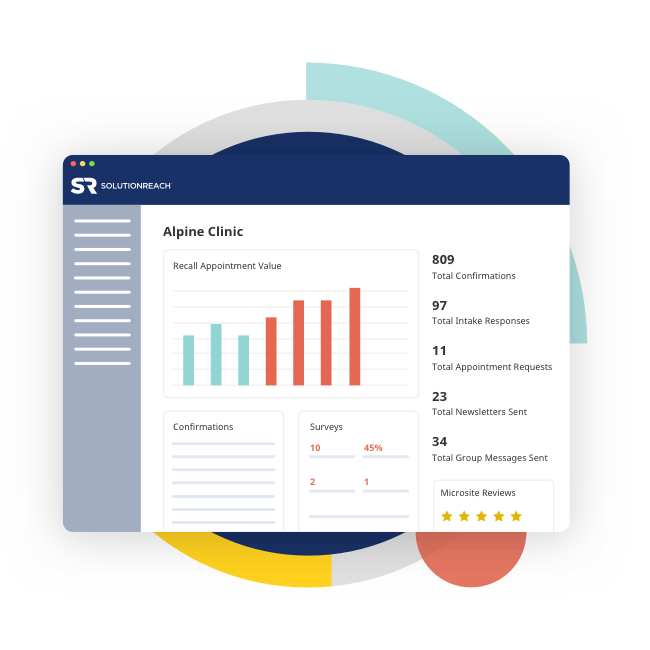
Solutionreach is a patient engagement platform that automates intake delivery for healthcare practices. Digital forms are sent to patients via text or email before their appointment. While completed information syncs directly into the practice's EHR or management system, reducing manual data entry.
This communication-first approach is a good fit if patient engagement and recall campaigns matter as much as intake. Moreover, Solutionreach connects form collection with appointment reminders, two-way messaging, and review management.
Key Features
- Automated form delivery via text, email, or QR-based check-in.
- Direct data sync with 400+ EHR and practice management systems.
- Two-way messaging, appointment reminders, and recall campaigns.
- Secure document sharing and e-signatures across workflows.
Pros
- Automated reminders and form delivery reduce no-shows.
- Flexible messaging options for patient outreach.
Cons
- Customer support is frequently cited as difficult to reach on Capterra.
- Recurring software bugs reported by multiple reviewers.
4. Phreesia
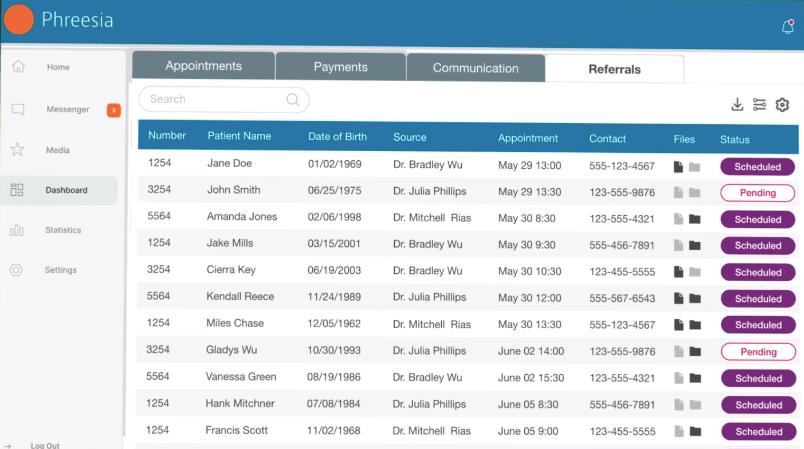
Phreesia is an enterprise-grade intake platform that automates check-in, registration, and payment collection. Patients complete HIPAA-compliant forms on their own devices before visits. While completed data flows into EHR systems for seamless record management. The platform also handles insurance verification, copay calculation, and digital payments.
Phreesia's scale matters for larger med spa groups or multi-location aesthetic practices. But for smaller practices, the complexity and cost may not justify the investment.
Key Features
- HIPAA-compliant digital forms accessible via mobile, tablet, or desktop.
- Direct EHR sync for patient-submitted data.
- Insurance verification, payments, and automated intake in one system.
- Customizable workflows based on appointment type, age, and chief complaint.
Pros
- Deep EHR integration, especially with systems like athenahealth.
- Customizable intake that adapts to different appointment types.
Cons
- Some patients report repetitive questions across visits.
- In-form advertisements appear unless the practice pays to remove them.
5. Zentake

Zentake is a digital intake platform built for simplicity. Healthcare providers can create HIPAA-compliant forms using a drag-and-drop builder, collect electronic signatures, and send forms to patients via email or SMS. The platform uses AES-256 encryption and includes a BAA on all subscription plans.
Zentake also offers good customer support and ease of onboarding. Multiple users highlight the dedicated account manager experience. For smaller aesthetic practices that want to digitize intake without a steep learning curve, Zentake delivers on that promise.
Key Features
- Customizable HIPAA-compliant intake forms with conditional logic.
- Electronic signatures for consent and treatment agreements.
- Form delivery via email, SMS, or in-office tablet.
- Data export and EHR integration (available as an add-on on the Clinic plan).
Pros
- Exceptional customer support with dedicated account managers.
- Clean, modern form design that patients find easy to complete.
Cons
- Limited automation and no forms tied to appointment types.
- No API available for custom integrations.
6. NexHealth
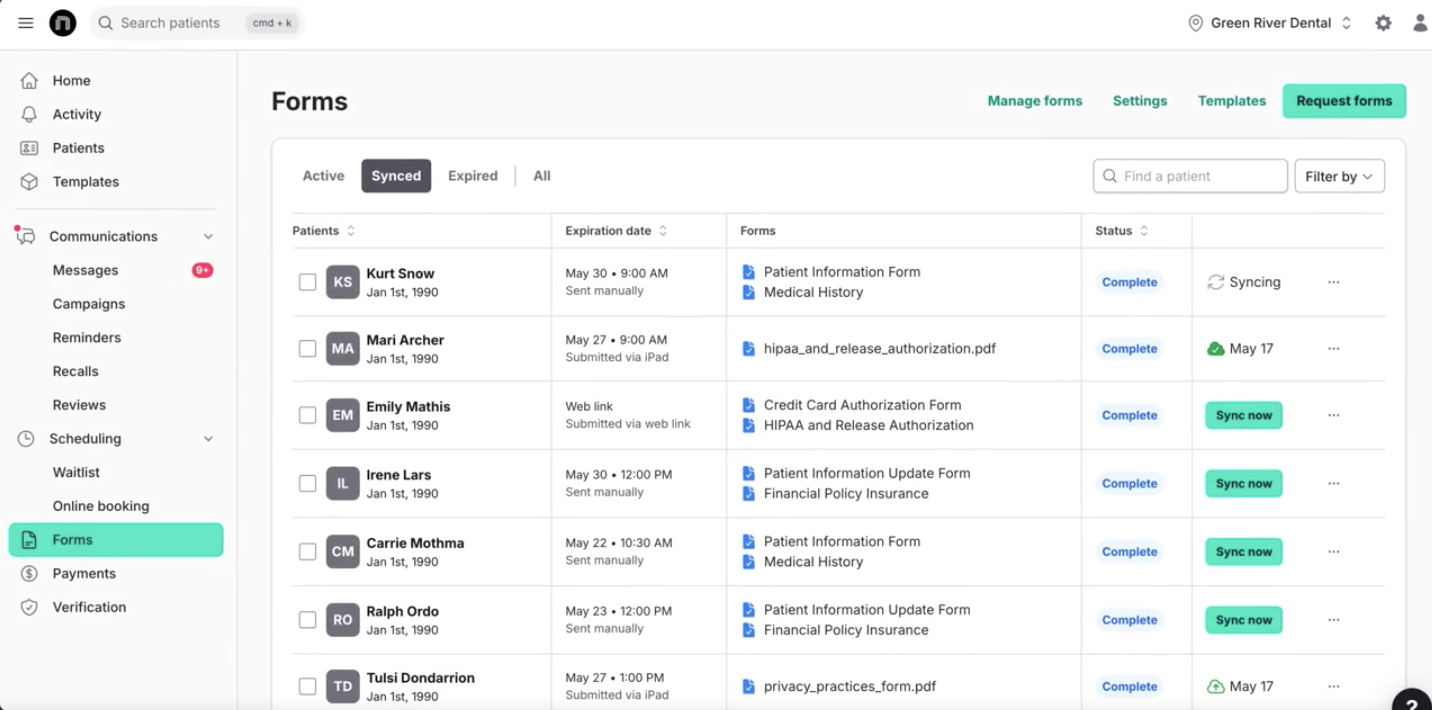
NexHealth is a patient experience platform that connects intake, scheduling, and communication through a real-time EHR sync engine. When a patient submits a form, the data writes directly into their health record within seconds. The instant sync eliminates scanning, manual entry, and the lag that comes with batch imports.
The platform also routes forms automatically based on appointment type. A new patient booking a consultation receives different intake paperwork than a returning patient scheduled for a follow-up. That logic runs in the background without staff involvement.
Key Features
- Form routing triggered by appointment type with no manual assignment.
- Custom form builder with logic-based fields for structured data capture.
- Built-in scheduling, reminders, and follow-up messaging.
- Two-way patient texting from the practice's own number.
Pros
- EHR data appears in seconds, saving significant admin time.
- Customer support earns consistent praise on G2.
Cons
- Pricing starts around $299-350/month, which is steep for small practices.
- Rigid contract terms with no refunds reported by some users.
7. IntakeQ
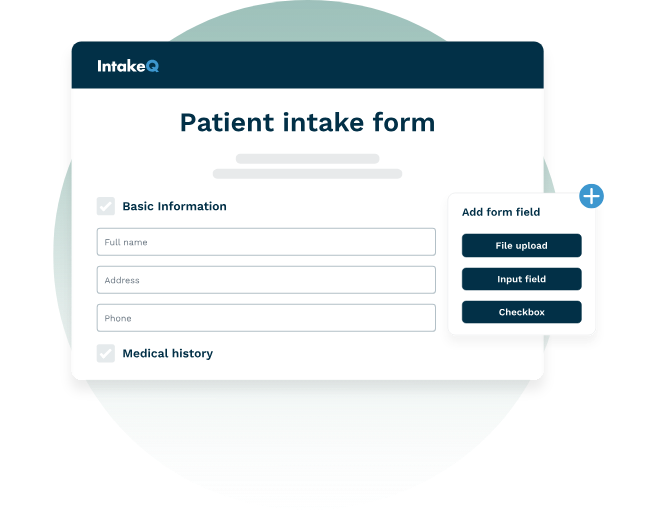
IntakeQ is a practice management platform with a good base in digital intake. Practitioners send HIPAA-compliant forms via text or email, and patients complete them on any device. The platform uses conditional logic so forms adapt based on patient responses. IntakeQ also covers scheduling, payments, telehealth, and billing.
The platform includes a form builder that’s flexible enough for complex assessments. Aesthetic practices that need more than basic intake but don't want a full enterprise system will find IntakeQ a good middle ground.
Key Features
- No-code drag-and-drop form builder with conditional logic.
- Form delivery via text or email with e-signatures on any device.
- Ready-made templates for faster intake and assessment setup.
- Scheduling, payments, telehealth, and billing in one platform.
Pros
- Highly customizable forms that adapt to different treatment types.
- Intuitive interface that reviewers describe as easy to learn.
Cons
- Not fully integrated with all EHR systems, which creates manual work.
- Occasional formatting issues when building complex forms.
8. Pabau

Pabau is an all-in-one practice management platform built for medical spas and aesthetic clinics. It combines CRM, scheduling, intake, charting, marketing, and payments in one system. Medical forms, consent collection, and patient records are all managed within Pabau. The platform also includes before-and-after photo tools and treatment tracking.
For aesthetic practices that want everything under one roof, Pabau is a good option. It holds satisfactory user ratings, with particular praise for its breadth of features and onboarding support.
Key Features
- All-in-one system combining booking, CRM, medical forms, and communications.
- Automated consent collection and patient record management.
- Before-and-after photo tools and treatment tracking.
- Reporting and analytics for performance and revenue monitoring.
Pros
- Comprehensive platform that replaces multiple standalone tools.
- Strong onboarding support with dedicated account management.
Cons
- Steep learning curve, especially for smaller teams.
- Add-on costs for SMS credits and marketing tools not always clear upfront.
Selection Criteria: How We Evaluated These Tools
We assessed each platform against criteria specific to med spas and aesthetic practices. These go beyond standard feature checklists:
Aesthetic Relevance
We prioritized tools designed for or widely adopted by aesthetic practices. Generic healthcare platforms were included only when their features directly addressed med spa workflows like consent management, treatment-specific forms, and photo documentation.
HIPAA Implementation
Each tool was verified to have a signed BAA, encryption standards (AES-256 at rest, TLS in transit), access controls, and audit logging. Platforms where HIPAA compliance requires expensive plan upgrades were noted accordingly.
EHR Connectivity
We evaluated native integration depth with EHR and practice management systems. Tools requiring third-party middleware scored lower than those with direct sync capabilities.
User Review Validation
Every pro, con, and feature claim in this article was cross-referenced against verified reviews on G2 and Capterra. We did not source claims from independent blogs or unverified aggregators.
Form Delivery Flexibility
We assessed whether each tool supports SMS, email, in-office tablet, and browser-based completion. Tools that require app downloads or patient account creation scored lower for patient experience.
Total Cost of HIPAA Compliance
Entry pricing can be misleading. So, we looked at the actual cost to access HIPAA features, including plan tier requirements, BAA availability, and add-on fees.
How To Pick The Right HIPAA-Compliant Online Form Builder
Choosing the right HIPAA-compliant form builder for your med spa means looking beyond the feature list. Here are the factors that matter most for aesthetic practices:
HIPAA Compliance Depth
Not all "HIPAA-compliant" claims are equal. Look for platforms that offer end-to-end encryption, a signed BAA, role-based access controls, and audit trails. For aesthetic practices collecting treatment photos alongside intake data, the compliance bar is higher than standard healthcare.
Integration With Your Existing Systems
Your intake forms need to connect with your EHR or practice management system. Manual data re-entry defeats the purpose of going digital. So, prioritize tools that sync data automatically, especially if your team already uses PatientNow, Nextech, or a similar aesthetic-focused system.
Patient Experience
Aesthetic patients expect a polished, frictionless experience from the first touchpoint. Tools that force app downloads or clumsy login processes before a patient can complete a form will hurt completion rates. SMS or email delivery with browser-based form completion removes that friction entirely.
Customization for Aesthetic Workflows
Generic intake forms don't account for treatment-specific consent, injection tracking, or photo documentation. The right tool lets you build forms tailored to Botox, fillers, laser treatments, and surgical procedures without hacking together a workaround.
Staff Adoption
A powerful tool that your team avoids using is a wasted investment. Evaluate how intuitive the interface is and how much training your staff needs before they feel comfortable. Mobile-first design is especially important for practices where staff move between treatment rooms.
Support Quality
When a compliance tool breaks or a form stops syncing, you need help fast. Check G2 and Capterra reviews specifically for support responsiveness. Some platforms on this list earn praise for support. Others have consistent complaints.
Choosing the Right Intake Tool for Your Practice
The platforms on this list range from simple form builders to full practice management systems. For med spas, the right choice depends on what you need most. Some tools focus on customization, others on communication or large-scale operations. But many med spas struggle less with forms and more with disconnected systems.
That’s where RxPhoto is different. It connects intake forms with photos, consent, and patient records in one place, so staff don’t have to switch between platforms. This saves time, gives providers full context during appointments, and creates a smoother experience for patients.
If your core challenge is collecting patient information securely while keeping it connected to clinical photography and treatment records, RxPhoto is built for that specific workflow. So, book a demo to see how it fits your practice.
Frequently Asked Questions
What are the best practices for selecting a HIPAA-compliant intake tool?
Prioritize platforms with end-to-end encryption, a signed BAA, and secure cloud storage. The tool should integrate with your EHR system and be intuitive enough for staff and patients with minimal training.
Can RxPhoto integrate with my EMR or practice management system?
Yes. RxPhoto integrates with PatientNow and other leading systems. Images, forms, and documentation stay connected to the patient record without manual uploads.
What are the core HIPAA requirements for online intake forms?
All data must be encrypted in transit and at rest. Access should be restricted to authorized staff only. A signed BAA must also be in place with the software provider. Furthermore, all forms must meet patient consent and privacy notice requirements.
What makes RxPhoto’s online forms HIPAA-compliant?
RxPhoto uses encrypted storage to protect patient data and photos. The platform manages consent digitally and attaches forms directly to each patient's record. So, sensitive information is only accessible to authorized providers.
Does RxPhoto support file uploads and signatures?
Yes. Patients can securely upload documents and sign consent forms digitally. All signatures and files also attach to the patient's record automatically.
Explore this post
Book a demo to see RxPhoto in action