
Quick summary
3D imaging captures a volumetric model of a face or body, which lets a surgeon simulate a result before the patient commits. That capability is real and nothing in 2D replicates it. Dedicated 3D capture systems also come as capital equipment, live in one room, and take time per capture, which is why practices that buy one for surgical consultations frequently still document everything else in 2D. Photo-derived simulation software, which builds a 3D model from a few standard photographs, avoids the hardware but still serves the consultation rather than routine documentation. This guide covers what each is actually built for, the questions that separate the two decisions, who each suits, and why a large number of practices shopping for 3D end up needing a 2D workflow instead, or both.
What 3D imaging does that 2D cannot
Worth being straight about this first, because the honest case for 3D is strong in its own lane.
Simulation. The patient sees a projection of a possible outcome on their own face or body. For rhinoplasty, breast augmentation, and body contouring, this changes the consultation. It aligns expectations, it surfaces disagreement before surgery rather than after, and practices that use it well report it helps patients decide.
Volumetric measurement. Actual measured change in volume and surface, not an impression from two photographs. For implant sizing, graft planning, and quantified assessment, that is a clinical tool rather than a marketing one.
Surgical planning. Standardized, measurable capture supports planning and academic work in a way flat images do not.
If your consultations turn on helping a patient visualize a structural change to their own anatomy, 3D does something you cannot approximate. No 2D workflow, however good, simulates a result.
What that capability costs you day to day
Not in money, which varies by system and configuration. In workflow.
A dedicated system lives in one place. Multi-camera capture systems occupy a dedicated room. Capture happens where the machine is, which means the patient goes to the machine.
A dedicated system takes time per capture. Positioning, capture, and processing are a real slot in the schedule, which is why it is used for consultations rather than for every visit.
It gets used selectively. The practical consequence of the two points above is that 3D is used for consults where it earns its time and skipped for routine documentation. Practices then document the rest on whatever is nearest, which is usually a phone, and that is exactly how you end up with an inconsistent archive.
A dedicated system is capital equipment. Purchase or lease, service contracts, training, and a replacement cycle, rather than a per-user subscription. Photo-derived simulation software is usually subscription-priced, so that decision turns on consultation value rather than hardware. That is a different kind of financial decision, and why the question deserves the time this guide takes.
The two questions that separate the decision
Almost every practice can resolve this with two questions.
Question one: does your consultation depend on showing a patient a simulated outcome?
If you are selling structural surgical change, often yes. A patient deciding on rhinoplasty or implant size benefits from seeing a projection, and that projection can be the difference between a booked case and a deferred one.
If you are selling tox, filler, laser, skin, or a weight loss program, usually no. Those patients want to see real results on real people who looked like them, which is a gallery of well-matched before and afters, not a simulation of themselves.
Question two: do you need to document every patient, or a selected few?
3D is built for the selected consult. If your requirement is a documented, consistent, marketable before and after for every patient across every treatment room and every staff member, that is a different job, and the one 2D standardized capture is built for.
Most aesthetic practices answer no to the first and every patient to the second. That combination points clearly at 2D, and most practices shopping for 3D have exactly that combination.
Where 2D is genuinely the better tool
Not a consolation prize. For the documentation job, 2D wins on the things that decide whether you have a usable archive in a year.
It happens everywhere. Every treatment room, every provider, no walk to a photo room. The capture that happens is worth more than the better capture that does not.
It happens for every patient. Coverage beats fidelity when the goal is a marketing library and a defensible record.
Consistency comes from the workflow, not the hardware. Fixed protocols and overlay guidance, where the previous image is shown as a ghost while framing the next, produce matched pairs across different staff months apart. That is the actual problem in most practices. It is a software problem, not a camera one.
Consent travels with the image. The question of whether a specific photo is cleared for marketing gets answered where the photo lives.
It is portable and it scales. Multi-location practices deploy the same protocol everywhere without buying a system per site.
The output is what marketing can use. A gallery of matched 2D before and afters is what patients look at when choosing a practice. A 3D model is a consultation tool, not a gallery asset.
Who each suits
A dedicated 3D capture system is well suited to a surgical practice where consultations turn on simulating structural change, particularly rhinoplasty, breast augmentation, and body contouring, with the consult volume to justify dedicated equipment and a room to put it in.
A 2D clinical photography workflow is well suited to med spas and aesthetic practices documenting injectables, laser, skin, and weight loss results; any practice that needs every patient documented rather than selected consults; multi-location groups; and any practice whose real problem is that its existing photos are inconsistent, scattered across staff phones, or missing marketing consent.
Running both is common and sensible in surgical practices. 3D for the surgical consult, 2D for routine documentation across the rest of the practice. These are not competing purchases in that setting; they answer different questions on different patients.
Before you buy either
Five checks worth running whichever way you lean.
- Who actually captures? If it needs a trained operator and that person is out, does documentation stop?
- What happens to the images? HIPAA-compliant storage, access controls, audit logging, and consent status apply identically to 3D and 2D. A capture system that dumps files onto a workstation has moved the compliance problem rather than solved it.
- Does it reach the chart? An image not attached to the patient record is an orphan file.
- What is the coverage rate? Ask honestly how many patients will realistically be captured. A system used on 15% of patients produces a 15% archive.
- What does the marketing team get? If the answer is not matched before and after pairs with consent attached, the marketing problem is still open.
How RxPhoto approaches this
RxPhoto is 2D clinical photography built for aesthetic and elective practices. It does not do 3D simulation. Where a practice genuinely needs simulation for surgical consultations, a 3D system is the right tool and we will say so.
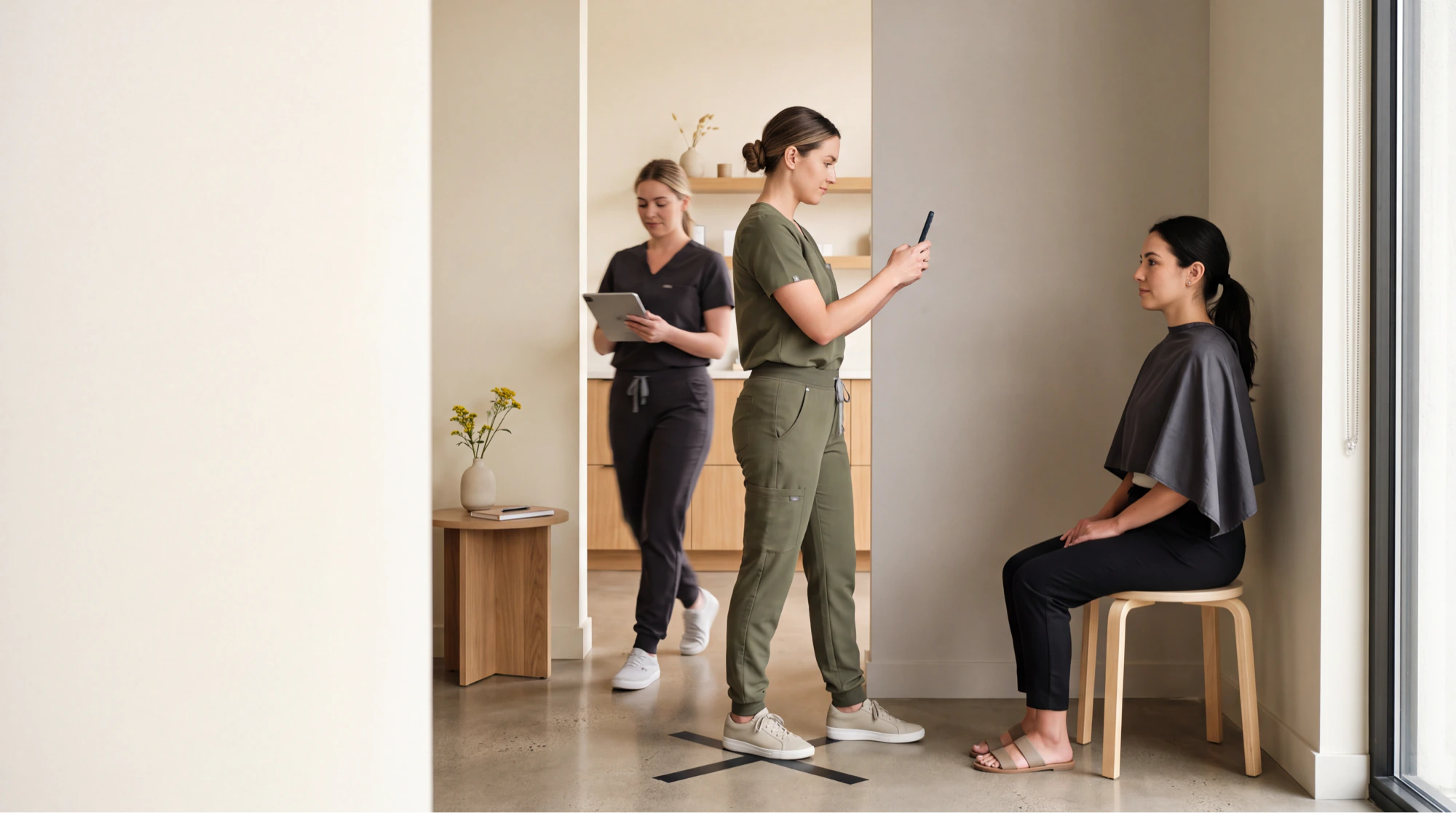
RxPhoto is built for the other job, the one most practices are actually failing at. Standardized capture on a device already in the room, with overlay guidance so the after matches the before across different staff months apart. Images landing in a HIPAA-compliant, access-controlled store attached to the patient record rather than a camera roll. Consent status traveling with the image, so what can be published is answered where the photo lives. The same protocol across every room and every location.
Two pieces worth reading alongside this. An RN working in a plastic surgery practice wrote on our blog about moving from Mirror Imaging and a dedicated camera room to a phone-based workflow, which covers the day-to-day difference better than a spec comparison can. And our roundup of plastic surgery apps covers the wider category including the 3D simulation tools, if you are still mapping the field.
Related reading
Frequently asked questions
Do I need 3D imaging for a med spa?
Usually not. 3D earns its place when a consultation depends on simulating a structural change, which is mostly surgical. A med spa selling tox, filler, laser, and skin treatments needs consistent documentation of real results across every patient, which is the 2D job. Practices sometimes buy 3D expecting it to fix an inconsistent photo archive. It does not, because the archive problem is workflow rather than capture quality.
Can 2D photos be used for consultations?
Yes, and effectively, though differently. Instead of simulating this patient's outcome, you show real matched before and afters from comparable patients. Many practitioners find that more persuasive for non-surgical treatments, because the patient is looking at an actual result rather than a projection. For structural surgical change, simulation does something the gallery cannot.
Is a 3D system more accurate?
For measurement, yes, meaningfully so. Volumetric change is measured rather than inferred. For documenting whether a treatment worked and showing it to a prospective patient, a well-standardized 2D pair answers the question, and consistency between the two images matters more than the fidelity of either one.
We already own a 3D system and our photos are still inconsistent. Why?
Almost certainly because the 3D system is used for consults and everything else is captured ad hoc on whatever is nearest. That is the normal pattern and it is not a fault of the equipment. The fix is a standardized 2D workflow for routine documentation, running alongside the 3D system rather than replacing it.
What about phone apps that claim to do 3D?
Depth-sensing phone hardware has improved and some apps produce a 3D capture from it. Treat the claims carefully and test against your actual use case, particularly if you intend to rely on measurement or to show a simulation to a patient. The gap between a novel capture and a clinically dependable one is where these should be evaluated.
If your real problem is that the photos you already have are too inconsistent to use, that is the 2D workflow question rather than the 3D one. Book a walkthrough and bring your worst before and after pair.
Explore this post
Book a demo to see RxPhoto in action